Chain of command
The Caine MutinyThe chain of command in The Caine Mutiny is the hierarchy through which orders, responsibility, and authority pass aboard ship. It makes coordinated naval work possible, but the novel tests its limits when Steve Maryk takes command from Philip Francis Queeg during a typhoon. The resulting court-martial turns a crisis at sea into a question about whether obedience protects a ship—or can prevent its officers from acting when its captain cannot.
Authority in Routine Shipboard Work
The chain is visible in ordinary procedure, not only in moments of confrontation. During a watch, Willie Keith receives a request from the forward fireroom for permission to blow its tubes and relays it to Maryk, the officer of the deck. Maryk grants it after checking the flag, but explains that a course change to position the wind would require the captain’s permission. The exchange distinguishes authority delegated to the officer on watch from a decision reserved for the commanding officer. The hierarchy is practical: it assigns decisions according to their scope and keeps routine operations moving without making every action a direct appeal to the captain.
A more disruptive example comes when Queeg attempts to maneuver the USS Caine away from USS Moulton. The ships collide, and the USS Caine becomes stuck in the mud. Queeg issues a tangle of wheel and engine orders amid the confusion; afterward, he asks Burt Gorton to inspect for damage and sends an apology to Duke Sammis. The episode exposes two sides of command. The captain’s authority remains the organizing center of the response, but rank does not guarantee sound judgment or prevent consequences. The ship’s formal structure assigns responsibility even when the maneuver goes wrong.
Queeg’s strict regime also reveals the gap between issuing orders and securing their consistent observance. The crew’s compliance follows a small area around the captain, expanding to what he can see and hear. New rules are enforced within that circle but ignored elsewhere, where sailors retain their own informal practices. This is not described as a coordinated conspiracy; it is a dispersed adaptation to the way authority is exercised. The contrast suggests that hierarchy can remain intact in form while losing practical reach. It also helps explain why the officers’ later dispute concerns not simply whether orders exist, but whether command is functioning as a reliable basis for action.
Emergency and the Limits of Obedience
The typhoon makes that dispute immediate. A huge wave breaks over the bridge, water floods inside, and Maryk urges that the ship turn into the wind. The USS Caine rolls so far that those in the wheelhouse slide across the deck, while John Stilwell reports that the gyro has gone dark. In such conditions, the chain of command is not an abstract rule: the crew needs decisions quickly, and the captain’s response affects the ship’s survival.
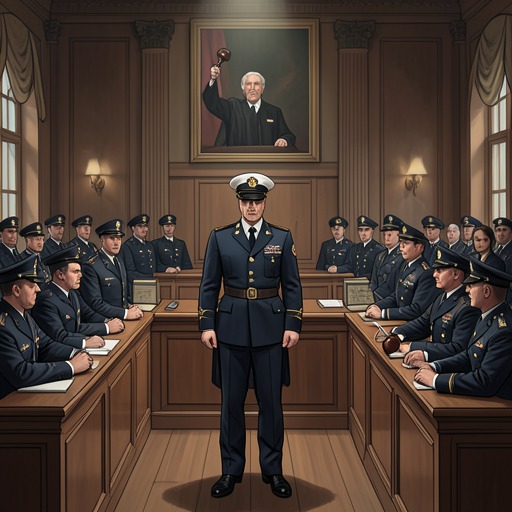
As the danger intensifies, Maryk takes command under Article 184, accepting personal responsibility for doing so and telling the other officers to follow his orders. Queeg calls the act mutiny and threatens those involved with punishment. Their confrontation gives the hierarchy its sharpest form: two competing claims to authority occupy the same bridge, one grounded in Queeg’s standing as captain and the other in Maryk’s judgment that the emergency requires him to act. When Stilwell spots a nearby ship or wreck, Maryk orders a hard turn and full astern. Once the USS Caine clears it, he orders the ship to circle twice and directs the crew to look for survivors. The rescue order makes the practical stakes of command visible: decisions made amid danger also govern whether the ship responds to people in need.
The dispute is further complicated by an earlier act of disobedience. At Maryk’s court-martial, Willie Keith acknowledges that he and Maryk and Stilwell had circumvented a captain’s order concerning Stilwell’s request to go home. Keith says that, in his view, all orders should be obeyed except irrational persecution; he also explains that he knew a letter could be sent to higher authority through the captain, but that the immediate priority was getting Stilwell home before they had to sail with Queeg for another year. This episode sets formal recourse against a subordinate’s practical calculation. The chain offers a channel for complaint, yet using it through the commanding officer may leave the person seeking help subject to that officer’s authority in the meantime.
The Court-Martial and Institutional Stakes
The prosecution argues that a captain’s mistakes, poor administration, or strictness do not authorize subordinates to depose him. Its concern is precedent: if officers can remove a captain for errors they judge serious, the chain of command may become vulnerable to mutiny. It insists that the legal question is not whether Queeg was a good officer but whether he was unmistakably insane under Articles 184, 185, and 186 of the Articles for the Government of the Navy. The argument distinguishes unsatisfactory command from the exceptional condition that could justify summary relief.
The prosecution also presents the presumption in favor of a commanding officer as institutional protection. Naval command is described as an extreme strain, and captains as people who may have serious weaknesses while still being able to command combatant ships. The Navy’s appointment system, in this view, makes the captain’s authority the default in disputes. That position gives the hierarchy continuity, but it also places a heavy burden on subordinates who believe a commander has become incapable of leading safely: dissatisfaction and error are not, by themselves, enough to displace him.
Keith’s testimony brings the general principle back to personal conduct. Asked whether the same disobedience would happen again under the same circumstances, he says it would. His answer does not erase the distinction between obeying orders and judging an order to be persecutory; instead, it shows how a subordinate may understand obedience as conditional in practice even while the institution depends on a general expectation of compliance. The prosecution interprets the officers’ shared history as evidence of collusion. Keith responds that he and Stilwell were on duty when Queeg broke down and that other officers in their positions would have acted similarly. The same acts thus carry opposed meanings: to the defense they belong to a genuine emergency; to the prosecution they threaten the authority that makes a navy function.
Retrospective Judgment and Significance
In a later letter, Keith revises his earlier understanding. He concludes that Queeg had conned the USS Caine for fifteen months, that the officers had transferred their anger about the war onto their captain, and that Keefer had put the idea of Article 184 into Maryk’s mind. Keith accepts responsibility alongside Maryk and regards the officers as having been wrong. He does not claim to know whether the ship should have gone north or south in the typhoon, but doubts that Maryk had to relieve Queeg. His reflection therefore separates uncertainty about the best maneuver from the question of who should hold command: in his mature view, the officers should have served under a flawed captain, covered his mistakes, and kept the ship going.
That conclusion sharpens rather than resolves the novel’s problem. Keith’s retrospective loyalty recognizes the burden of command and the danger of treating a subordinate’s judgment as an easy substitute for a captain’s authority. Yet the earlier scenes have shown that procedure depends on people exercising judgment at the watch, and that emergencies can demand action before ordinary channels settle a dispute. The chain of command is at once the structure that coordinates the ship, the system that makes responsibility legible, and the rule the officers must decide whether to break when they believe obedience itself has become dangerous.